Written for the Winter 2026 Backpage of Kappan Magazine
There’s something valuable in our exploration of culture and existence through the lens of science fiction. Ray Bradbury said that he was a “preventer of futures, not a predictor of them,” in relation to his authorship of Fahrenheit 451. Growing up in the 1980s, I can still remember the wonder of watching Michael J. Fox ride into the future in his modified DMC DeLorean. Or even Matthew Broderick in War Games, using his modem at home to dial up to a government computer and launch a thermonuclear war simulation, that by the movie’s end, nearly triggers a real retaliation. Those stories themselves were fun, but the value is in how they can get us to reflect not only about what’s coming, but about what’s already here.
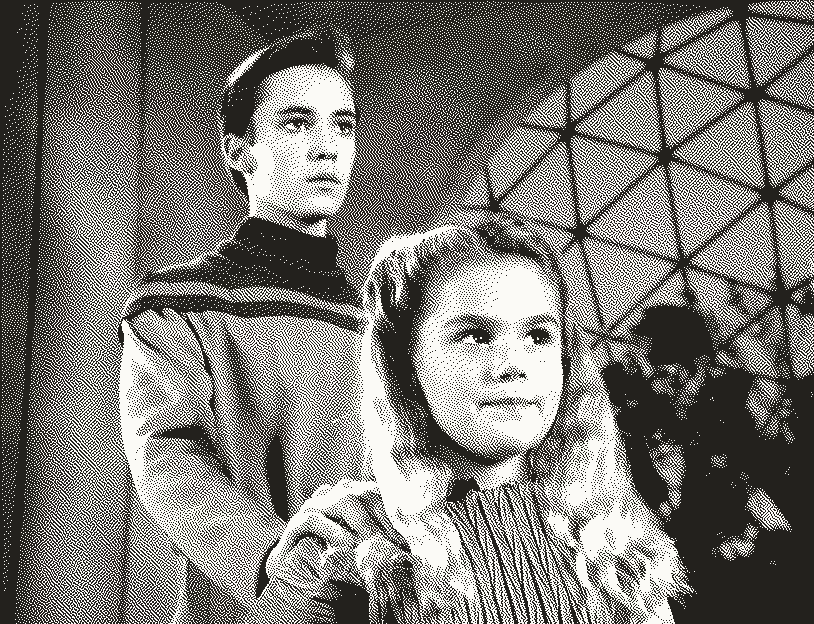
It was in 1988 when Patrick Stewart, playing Captain Jean-Luc Picard with his “Next Generation” crew, visited the planet Aldea in a StarTrek episode entitled When the Bough Breaks. They encounter inhabitants who have become infertile through their dependence upon “The Custodian,” a machine that the crew recognizes as an ancient computer. They have learned to trust this Custodian but ultimately come to realize they need the intervention of Will Wheaton’s character, Wesley Crusher, along with the crew to set things right again.
The 80s were also the time of the advent of the inexpensive solar-powered calculators that began appearing in schools. Educators had doubts about these devices, some suggesting they be banned, having no place in mathematics instruction. More than a decade later, Doug Johnson published a satirical Education Worldcolumn entitled “A Proposal for Banning Pencils” (December 6, 2005). He suggested, in jest, that school committees might consider banning pencils in schools because they could cause injury, be used to scribe threatening messages, be stolen, or distract students if they might be used for doodling. It was an apt reflection on contemporary calls for banning other technologies in schools, such as MP3 players. His principle was “The abuse of a thing is no argument against its use.”
Nevertheless, we’re seeing history repeat itself again with attitudes around the use of artificial intelligence, or if you are so-inclined, super intelligence in schools. Educators learned that you can leapfrog into more complex math if you weren’t spending time covering basic arithmetic, which the calculator did without complaint. English teachers saw the potential of improving student writing with the use of word processors and their embedded spell-checkers. While yes, a fancy graphing calculator can be used to cheat on a test, or the word processor can be used to copy someone else’s writing and ideas, the abuse of these tools doesn’t mean we shouldn’t explore their potential benefits. We could say the same thing about A.I. too, right?
Sometimes I think back to that Next Generation episode, though, and pity the Aldeans. Their computer was so old that no one knew how it worked or how to fix it. Yet, they’d become reliant upon it. The funny thing about A.I. is that it learns, and it learned from us. While there’s little doubt that A.I. can provide utility to today’s knowledge worker, are we not concerned that it could become for us what the Custodian became for the Aldeans?
Of course the Aldeans weren’t real. They were science fiction. And while that episode feels at least an eon or two old to me now, it still might be ripe for reflecting on what’s happening as we think about the role A.I. can play in the field of learning. Which means, perhaps, not banning A.I. from classrooms, but teaching students how super intelligence gets created in the first place.