
NECC 2009
I presented at NECC (now ISTE) 2009 on blogging. The references used for the talk, the state of the web, and the novelty of writing and publishing online came back to me in a way that today (2026) feels overly nostalgic.
From a design perspective on that deck, I’d created a WordPress theme (yellow, with the white outline) that I was using on my slide decks as well, for some synergistic aesthetic between screen and the web. But that small detail aside, the presentation seems pretty basic.
I led a discussion about blogging platforms, school policies around blogging, blogging lingo (such as a blogroll), defining the role of a blog alongside other published media, and then a look at my six-year journey running blog servers as part of my work at Goochland County Public Schools.
The Journey
I remember specifically why I installed Plone on a server. It was new, yes, and I had a teacher who was really pushing me to have a place to park content for her students. She operated out of a computer lab so she was basically asking for a CMS of some type, and this was before we’d even consider something specific to education like Blackboard. This again, was probably 2004!
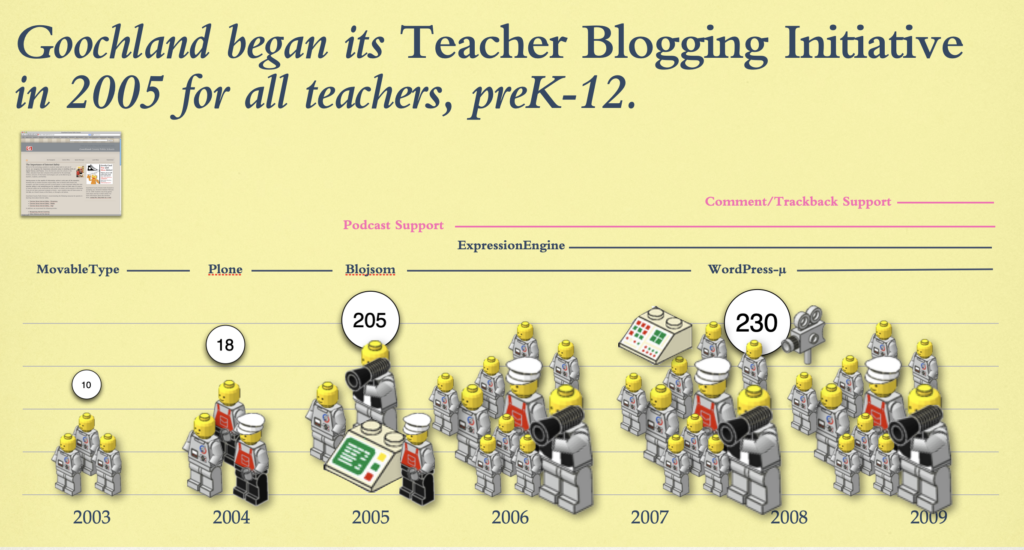
When I say I’m a pioneer with blogging in education, this picture kind of tells the story. In 2004, I had eighteen teachers putting content voluntarily on that Plone server, having to learn Plone’s own markup language. We replaced that with one of Apple’s server products that supported the Blojsom engine in 2005. And it was at that point that we made the blogging piece a requirement after I’d made a pivotal presentation to our school principals.
In 2006, I changed our website to a CMS with Expression Engine. At the time it seemed to be an up and coming new and powerful blog-capable CMS for a website and I became technically adept at all of its features. Those were good times.
Apple’s Tiger server eventually buckled under the stress of supporting 200+ blogs with it’s Tomcat (Java) engine and we moved to WordPress MU (2008) and changed platforms. It was again served on MacOS X Server (an updated box, for sure) and eventually I moved our website to a different instance of WordPress for our division’s website around 2012-2013. The division turned everything off after my departure, going with a commercial web services provider, one that seemingly every school system adopted. Makes me sad, actually, as our homegrown site on Expression Engine and WordPress was so much better.
The “blogging initiative” was shelved when our school division adopted Schoology. However, if you look at the years, we had a good ten-year run of teacher blogging across our division.
Preview
In 2007, I presented on our blogging initiative with our superintendent, Dr. Frank Morgan. This highlights that presentation ahead of me going to NECC.
Best Practices Today
The Platform Question
The rise in blogs and blogging was so profound in the first ten years of the new millennium that you might well predict that it would just take over the world. Everyone can publish! The tools and platforms have come a long way. Clearly WordPress is the predominant tool. What makes it so strong a contender is that it can be self-hosted (free software!) or you can have someone host it for you, and no matter, the interface and experience is consistently the same. With the large community of plugin makers, theme creators, and the like, it’s a fully-spec’d system that is easy to use.
What I didn’t expect to see was the rise of blog platforms like Substack and Medium emerge. Blogger (acquired by Google) was a kind of everyman’s platform. Where’s your blog? You’d go to Blogger and have your account. Tumblr followed, offering an even simpler interface which became known for specializing in visuals. But today Substack is really for people who are serious about writing, people who are serious about reading, and together, these tools are more than just about publishing, but creating community. You don’t want to fiddle with blog themes or plugins. You want to get your stuff out there. And today some people use LinkedIn as a platform as well. The advice I have: there are challenges finding community. And if a platform can help you develop community, then great. Because your content isn’t worth anything if it isn’t being consumed.
The Need to Share
I do think, now in retrospect, that our society went through a kind of collective experience of feeling that they needed to share. Not all of society, but those technically-literate people who were online every day and were interested in new media.
What did MySpace, Blogger, Tumblr, and name five more platforms teach us? Creating is fun. Consuming it all was a challenge. And just because you could publish didn’t mean you should.
Back in the day, say 2009, when I was at NECC presenting, I remember a number of prominent teacher/educator bloggers like Vicki Davis, the so-called Cool Cat Teacher (see her original Blogger site). She represented for me an educator that clearly had something to say and by any stretch, she’d gained a following. Through publishing, a number of educators amplified their reputations through the act of publishing.
I was inspired outside of education. The guy I need to credit for introducing me to blogging was Jason Kottke. Today he remains one of the few professional bloggers and among the first. Like many at the time, he wasn’t as much a writer as a web designer. This was back in the late 1990s when it seemed if you wanted to legitimately be a netizen you wanted to have your own “homepage.” I was excited about it, actually. I didn’t maybe yet realize it, but my own essence was that of a creative, someone who wanted to make things and put them out into the world.
And as far as educators, not everyone’s personal Venn diagram shows an overlap of creator and educator. We should have outspoken educators who publish and put their ideas out in the world. But it doesn’t mean you’re not a good educator if you don’t do that. Right?
Our Original North Star
When I introduced teacher blogging to my district/division, it wasn’t to amplify each teacher’s voice and get them putting content into the world at large. The purpose was more pragmatic: we asked how the platform and the act of blogging could help better inform parents about what was happening during the school day. We set an expectation that teachers would post at minimum weekly. “This is the plan for the week…” Some teachers embraced the idea, others pushed back, but eventually we got a good rhythm going with the support of our central office leaders and principals. Later when the LMS came, it was an easy change, set with the same expectation: let’s give parents all we can to enlist their support from home.
Your Voice
I remember many early blogs were like diaries. Of course this was before Facebook’s proliferation into society and the other social platforms like Twitter/X, Instagram, Snapchat, etc., etc. I remember a few teachers using their blogs to rant. Probably not a great idea once parents found those posts.
I do think you need a purpose in setting out to blog. If you want to use a blog platform as a diary, then set it to private and go to town. Share it with your kids some day. But for those of us who want the world to read what we’re putting out there? What’s your point of view? To quote the doctor from my presentation, what’s your focus going to be?
As an educator I think about the instructional value of my writing. I publish Guides here, when I figure something out and figure I can help someone else by publishing my findings. Such an example that I have on my Biberfan site is how to rip SACD discs on a Macintosh. The post is by far the most popular one on my website. More than any review!
To find that voice and that focus, I’d encourage you to simply write first. Don’t worry about the platform or the theme or any of that. Just write. Use AI to clean up your writing, if you’re not a confident writer. Then come back. Do you see the value that others might gain from your ideas?
For me, great reasons to write as an educator include:
- Lesson plan ideas,
- Documenting professional breakthroughs,
- Documenting the innovative ideas you’re using in the classroom,
- Lessons of leadership,
- Sharing the joys and positive aspects of teaching and education,
- Celebrating your wins,
- Helping people see things that only you can show them.
And then put it out there.
John Gruber, another blogger who I have followed for most of his blogging career, once wrote that in thinking about his own blog, he writes the type of content that he himself would want to read. That statement is so profound to me. It guides my own use of these tools. It guides what I do over at Biberfan. I write the type of reviews I’d like to have found and read.
And I am the one who can do that.
And once you choose a platform and set up your actual blog, well, be prepared. Have a backup plan. And I mean how to back up your writing in case the site goes down, kaput, or whatever. I’ve lost content! I should have kept the decade of teacher blogs we did in Goochland.
I also mean to say be prepared that you’ll find critics for your work. Not everything I’ve written or put out into the world has been well-received. That’s okay. Sometimes it’s because I did a poor job, and other times because a reader and I just don’t see eye to eye.
You do have to have a thick skin. But if you have that focus and you have what you feel is truly your own point of view? Let that voice of yours be heard.
Today we have a lot of ways to get our ideas out into the universe. Blogging proper is just one, and it may not be the best one for you. Yet if you choose to blog, give yourself a chance to find that voice, a following, and yes, follow others. Blogging is still one of the ways to find community across the world. Pay it forward by letting other writers know you care (with a like, a comment, or by following their RSS feed).
Is RSS still alive? That’ll be another post.