A version of this article will appear in the Fall 2026 edition of Kappan.
When one ponders the future of education, it’s apt, perhaps, to consider the future of schooling. We’ve taken for granted that schools exist. I’m guessing you attended a few in your day.
Ask any parent, and they’ll find a way for their child’s school to improve. It could be trivial, like this year’s new start time, or a matter of convenience, such as how well your kid likes the food served for lunch in the cafeteria. To a more urgent degree, you might be dealing with a bully at school, or become worried by the language that’s bantered in the bus by the older children who share the ride home with your own. And then you think… are the seats on that bus disinfected? Is your daughter’s teacher adding her own personal spin on the district’s drab lessons? And is there still time to perhaps switch her into that more seasoned teacher’s class, the one you used to hear everyone raving about at swim practice last year?
Schools! Imagine if you didn’t have to settle.
In March of this year a humanoid robot walked the red carpet into the White House East Room alongside the First Lady, introduced itself as Figure 03, and welcomed the guests in eleven languages. I am not making this up. Mrs. Trump then invited us to imagine a humanoid educator named Plato — humanity’s entire corpus, available in the comfort of your home, adaptive to each student, always patient and always available.
Always available. Consider what your child’s teacher currently is: available until 3:40. I know they can be contacted via the school’s LMS after hours, but you already know she’ll wait until 8:10 the next day to get back to you.
Consider the other negatives of schooling. Like the events. Hauling back your kid to school in the evening, after a full day there already, for a play, an academic fair, or god forbid if they took up the tuba, the band concerts.
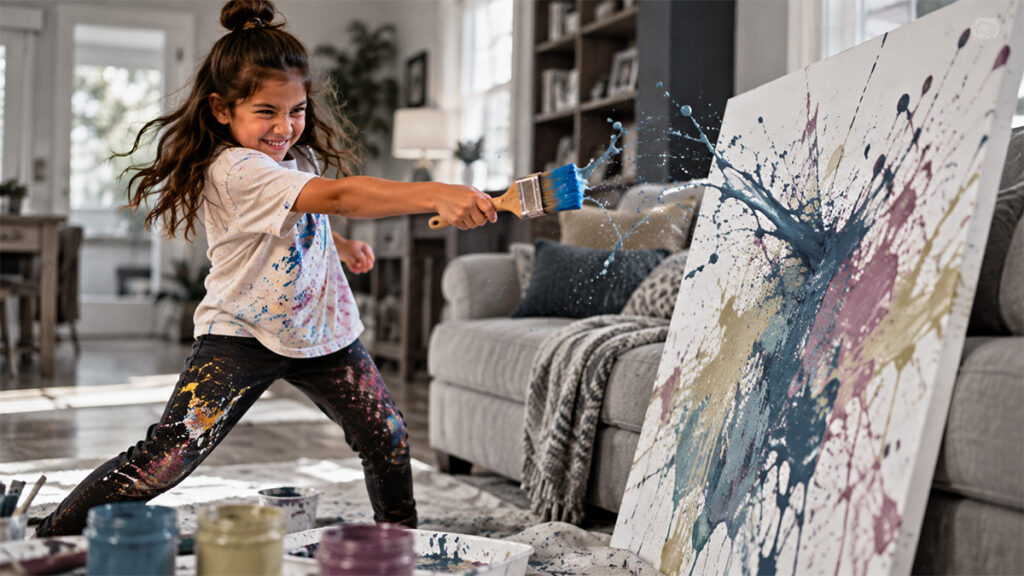
With Plato, we can likely cancel the band concerts. Your child can be coached by an AI carrying the insight of a hundred world-class soloists. It will never tire of correcting a hand position on the flute, or a bow grip on the cello. Athletics more your thing? Load the decathlon package. The visual arts can thrive in your own home: what other fifth grader is coached by VirtualPollock, exploring first-hand the myriad ways to fling paint at a canvas? And, yeah, maybe the sofa?
If you think about it, whole disciplines could go obsolete! Driver’s ed — the car drives itself. World languages — the earbud translates. The law: seems hardly necessary as my aunt ordered a CD-ROM a decade ago and printed a last will and testament for each and every grandchild.
Mathematics gives me pause. It still seems useful, given climate change and pandemic infection rates and all of that. But in 1975 we were certain the pocket calculator would ruin a generation, and we were right — nobody does long division anymore — and the bridges are still standing. Then this June an OpenAI model made real headway on the Erdős unit distance conjecture, an eighty-year-old problem about how many pairs of dots in a plane sit exactly one unit apart. A Fields medalist called it a milestone. The machine invented nothing new. It simply combined what was already lying around, exhaustively, without ever once getting bored.
Which, now that I say it aloud, also describes my ninth-grade geometry class. The teacher meant well, I can assure you, however it was the only room in the building without windows. But plenty of chalk dust. Yuck!
It may just be a matter of time then, for the maths.
Family and consumer sciences gets condensed into a brief tutorial on the DoorDash app. (The children will still need to eat!) Reading survives, though books yield to flexible screens scrolling an endless suite of content past our eyeballs at a speed we control with a ring on the finger. The research was done years ago at Xerox PARC and is called “rapid serial visual presentation.” If you ask me, it makes books obsolete, except someone will have to keep the kids from going cross-eyed by thirteen. I’m hoping we can teach Plato to urge your kid outdoors, with what they used to call a game of catch. I wonder if Plato could conduct a vision test, too?
You might be thinking I’d be against this robot teacher at home kind of thing given my background in music education. But I’ve sat through recitals. No one really wants to hear the other students play, unless they flub. If you’re a kid waiting for your turn, the best that can happen is that no one before you or after you plays their piece perfectly. But with Plato, the amount of expertise your child will have? Your kid will play that sonata beautifully, with a perfect embouchure. His intonation will be verified to the cent. Plato applauds, for sure, as the always patient and always available guide, from the comfort of your home. Plato can upload the AI-enhanced performance online and you can almost taste the anticipation of everyone’s positive comments.
“Billy is so talented,” his grandmother opines. “Back in my day, my mom sat through my recital with cotton in her ears!”
And the best part? No one has to actually be in the room. There was never going to be anyone else in the room. That was the point. With Plato schools can cancel those expensive music programs. A band, after all, isn’t a skill. It’s other people. And the trouble with other people is that they’re late, they’re flat, and one of them very likely is the bully who is nearly obsessed with putting his chewed gum in other people’s hair.
And let’s just put an end to those practice records that the band director uses to grade your kid? Plato has it covered. Automagically.
They named this new robotic instructor Plato. The curious part is, the historical Plato used a method where we get to argue with others. It’s not all bad, though. This Plato will teach your kid discipline. Like remembering to plug Plato in each evening before bed.
And the best part of doing away with school and unboxing Plato? Every child can now have their own bathroom.
Notes
There’s something rather absurdist about a robot teacher. Much in the same way we might think about a student sitting in front of a laptop all day to receive their education. Of course, this essay leaned into absurdism to play out the possibilities. Schools aren’t perfect but neither is life. It’s that friction that we can either let get the best of us, or use it learn, adapt, and grow from.
I wrote this piece in the summer of 2026 just as the shockwave of anti-tech sentiment began to appear in the press. School boards debating the utility of computers in schools. They’d taken the cell phones, and now, the tablets and the laptops.
One might think that a robotic teacher presented to the nation as Mrs. Trump did was not ideally considered, given the public sentiment about screens and learning from technology. But maybe I’m wrong. Maybe the public would be more welcoming to a screen-less android who speaks multiple languages and walks slowly but with careful steps.
A former colleague of mine recently reached out to tell me that her role as a technology coach had been traded for a more generalized instructional coach. The one-to-one program had been dismantled, the devices either returned to the manufacturer, or stored in the district’s warehouse for a summer enrichment camp. Keyboarding instruction would be replaced by cursive handwriting. And the technology budget would go back to the school librarians, who could finally stop scraping gum off the old book covers and finally replace some of their worn-out books.
I’m not sad that more books might be purchased or that students may get the opportunity to practice the many ways one can write a capital “F”. It was one of my favorite letters, personally. Although I never understood why in our D’Nealian Method workbooks we were taught to write the “Q” that way.
The thing is, the backlash against technology (or screens more properly, as clearly Plato is destined to arrive soon after Christmas) was easily predictable. As my colleagues and I wrote in our dissertation in practice, Ubiquitous Computing in Schools, the success of any one-to-one program was to build the goals for that program around an instructional model that offered students a clear instructional advantage. Technology can make learning look different or it can make the whole enterprise more efficient. It’s a simplistic way of thinking about it, but the efficiencies help the teacher, far more than they do the student.
My own experience in launching a one-to-one was to focus on the opportunities for deeper learning with technology. So instead of using the computer for drill exercises or to help the teacher with an auto-graded assessment, use it for analyzing video footage of a student shooting a hoop in the gym for better understanding physical principles. Or teach someone a concept by creating an instructional video. Or create social media assets that both educate and encourage the community to rally around a cause that’s important to that student.
And as interesting as Figure 03 may be on the surface, it can’t replace a teacher. And it’s not going to be used, if it ever has the opportunity, to encourage deeper learning. Instead it’s going to be applied to the worst kind of efficiency, taking the human component out of the educational picture.
And just for the record, I’m fully against eliminating schools and putting robots in the home. The public schools remain—even if imperfect—one of the most profound inventions to advance human development within a democratic society. Students need the nurture and expertise from human educators who form with students real relationships as part of the complete educational experience.
And yes I’m sad that some districts are scaling back their reliance upon technology in their classrooms, but maybe it’s not all bad. Because without fully committing to thinking about how technology can provide deeper, richer, and more compelling ways for us to teach, replacing the human component of learning for the benefits of efficiency is just about as absurd as installing Plato in your home.